Copper can move several cents a pound in a single trading session. In most months, that swing gets absorbed into the next price sheet update. In summer, when trading volume thins out and a single large order can move the market, that same swing hits harder and more often. If your pricing process still runs on a sheet someone updates once a day, summer is exactly when it starts costing you money.
Commodity price swings aren't random. They follow patterns, and several of those patterns cluster in June, July, and August.
Mills and smelters schedule planned maintenance shutdowns in summer, temporarily pulling supply out of the market and creating short, sharp price spikes when demand doesn't adjust with it. Trading desks run thinner over the same stretch: vacations and holiday-shortened weeks (Independence Day, Labor Day) mean fewer participants and lower volume on the exchanges that set the benchmarks scrap prices track, like COMEX and the LME. Thinner markets move more on the same size order, which is why a single large trade can swing a benchmark price further in July than it would in October.
Construction season adds its own pressure on the demand side. Ferrous and non-ferrous demand from builders and infrastructure projects peaks in the warmer months, pulling on the same steel and copper scrap streams that feed mills and foundries. Weather adds a third variable: heat waves that strain power grids, hurricanes that disrupt Gulf Coast logistics, and wildfire smoke that slows freight all show up as short-term price and supply disruptions that a fixed monthly price sheet has no way to reflect.
None of this is new to anyone who has run a scale house through a summer. What's easy to underestimate is how much that volatility compounds when your pricing process can't keep up with it.
Walk through a typical yard's pricing process and you'll find some version of the same setup. Someone, usually a purchasing manager or a branch controller, checks the market each morning and updates a price sheet by grade: number one copper, insulated copper wire, shredded steel, aluminum extrusions, and dozens of other line items, each priced separately and often differently by location or supplier tier. That sheet gets pushed out to the scale house, and scale operators price tickets against whatever number is on it for the rest of the day, sometimes for the rest of the week.
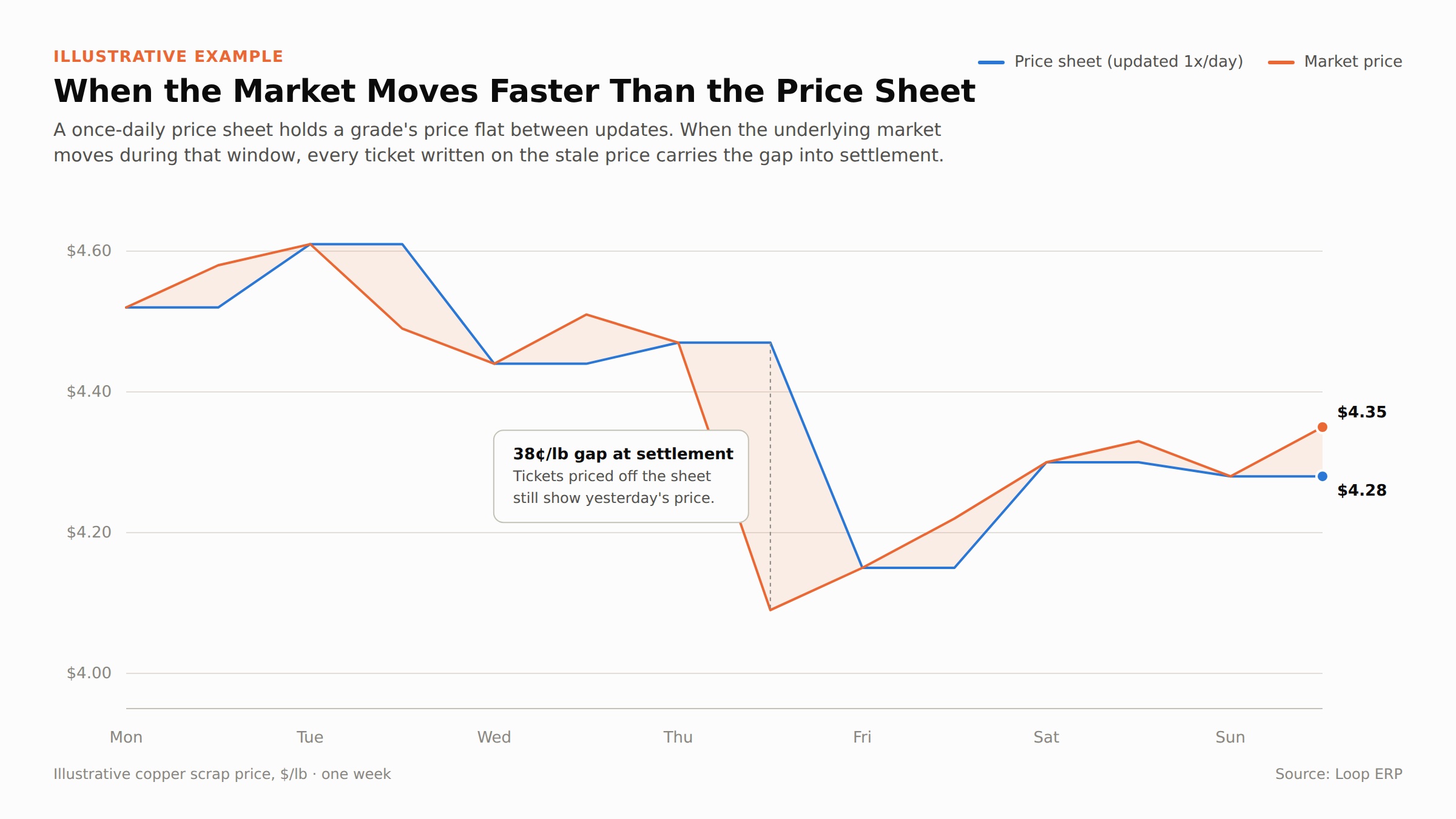
That process works fine when prices hold roughly steady. It starts to break down the moment the market moves faster than the sheet does, which is exactly what happens more often in summer. A price sheet updated at 7 a.m. is already stale by the time an afternoon truck rolls onto the scale if copper has moved 3 percent since the market opened. Multiply that lag across every grade, every yard, and every day of a volatile month, and you have a pricing process that's structurally a step behind the market it's supposed to reflect.
Most scrap operations don't pay the full agreed price the moment material hits the scale. They pay a provisional price at intake, then settle the balance later once final weights, grades, and moisture or contamination adjustments are confirmed. That model works well when the market is calm. It gets risky when the market moves between the ticket and the settlement, and the pricing process behind it is a spreadsheet someone updates by hand.
Here's the mechanic that causes the damage: a scale operator writes a ticket at the price loaded onto the sheet that morning. Copper drops 40 cents a pound before the load is even processed. Nobody catches it, because catching it means someone manually rechecking the market and re-keying every affected price grid across every grade and every location. By the time the load is graded, processed, and settled days later, the company has paid out at a stale price on volume that should have settled at the current market. Multiply that gap across dozens of grades, several yards, and a hundred tickets a day, and it's not a rounding error. It's a margin leak that shows up in the books weeks after the material has already shipped.
This is also where reversals pile up. Scale operators and accountants end up chasing down mis-priced tickets; some operations report ten to fifteen manual corrections a day, and larger multi-site operations report over a hundred. Every one of those corrections takes a person away from other work, and every one breaks the clean audit trail between the scale ticket and the final settlement.
Getting ahead of this isn't about checking prices more often. It's about removing the manual step between the market and the price a scale operator sees.
That means grade-specific pricing tied to a live index or contract formula, not a static number someone typed in last week. Index pricing against a benchmark like COMEX or the LME, spread against a published trade reference, or run through a supplier-specific formula all need the same underlying capability: the price a scale operator sees has to trace back to a current market number, not a sheet that was accurate this morning.
It also means the price on the ticket and the price used at settlement come from the same source, so there's no drift to reconcile after the fact. Contract and PO pricing, spot pricing for walk-ins, and tiered pricing by supplier or volume all need to run on that same live foundation, because a system that handles one pricing type well but falls back to manual updates for another just moves the risk instead of removing it.
And it means provisional pricing is built into the workflow itself: lock a percentage of the agreed price at intake, hold the balance open, and true it up automatically once final weights, grades, and any contamination or moisture deductions are confirmed, rather than as a separate manual pass at month-end. Done well, provisional pricing gives a supplier a fair estimate at the scale without forcing your finance team to guess at what the eventual settlement will look like.
Settlement reconciliation follows the same logic. A settlement should consolidate the inbound ticket, the final weight, the grade adjustment, freight, and the price actually in effect into one record, with a clear audit trail back to the original purchase order and ticket. When that consolidation happens automatically, finance isn't left rebuilding the math after the fact to figure out whether a supplier was paid correctly. When it happens by hand, every summer price swing turns into another reconciliation project.
Volatile pricing periods expose whatever gap exists between your yard and your finance system. A generic ERP or a spreadsheet-based process might hold up fine in a quiet month. Summer, with thinner trading volume, maintenance-driven supply shocks, and weather disruptions layered on top of normal demand swings, is when that gap turns into real dollars.
The fix isn't more spreadsheet discipline. It's a system where pricing, ticketing, and settlement all draw from the same real-time data, so a market move shows up once, in the right place, instead of turning into a stack of corrections three weeks later.
If you want a closer look at how price swings distort inventory value and reported margin, and what it takes to track your real numbers through a volatile market, we cover that in detail in our guide to tracking commodity price swings and inventory value.
Loop ERP connects yard operations, provisional pricing, and settlement reconciliation in one system, so a price move at the scale and a price move on the books are always the same number. If you want to see how that works for your operation, book a consultation with our team.
Powerful, self-serve product and growth analytics to help you convert, engage.
Blogs

September 16, 2026
Material Traceability Software: What ESG and Compliance Teams Actually Need

September 10, 2026
Scale House Software Explained: Ticketing, Dispatch, and the Financial Handoff

September 3, 2026
What ERP Do Scrap Yards Use? A Buyer's Guide for Q4 Planning Season