Loop ERP vs. cieTrade: Unified NetSuite ERP vs. Best-of-Breed Trading Platform
cieTrade has spent over 20 years building trading and yard software for scrap, plastics, paper, and brokerage operations, and it shows in the depth of its ticketing, grading, and pricing tools. Loop ERP takes a different architectural approach: instead of connecting to an accounting system, it's built natively inside Oracle NetSuite, so operations and finance run as one system rather than two. This comparison looks at where each platform stands on functionality, scalability, integration, compliance, and cost.
Product Overview
Loop ERP
Purpose-built operations and finance software for scrap, recycling, and circular economy businesses, built natively inside Oracle NetSuite. Ticketing, inventory, pricing, settlements, and dispatch post directly to NetSuite's general ledger the moment they happen, so there's one login, one database, and one system of record for the yard and the books.
cieTrade
Trading and yard management software for scrap metal, plastics, paper, and other commodity recyclers, marketed as "best of breed" rather than a full ERP. Covers ticketing (touchscreen kiosks, license and fingerprint scanning, camera documentation), inventory by lot and warehouse, spot and contract pricing with index formulas, production tracking, brokerage and export paperwork, and scale integration. Connects to QuickBooks, Sage, NetSuite, Xero, or Microsoft Dynamics 365 Business Central for accounting through real-time or batch API integration.
The Competitive Landscape
A. Functionality and Features
cieTrade:
Deep, mature feature set for ticketing, grading, and pricing, refined over 20+ years in the trading software space
Flexible "worksheet" model for building pricing and settlement logic around specific commodity relationships
Mobile documentation tools (ciePhoto, cieDispatch, cieMobile, clickBale) for yard and field workflows
A self-service portal giving customers and suppliers visibility into inventory, pricing, and payments
Positions itself explicitly as best-of-breed trading software, not a system of record
Loop ERP:
The same operational depth (tickets, grading, pricing, settlements, dispatch) plus financial functionality (GL, AR/AP, multi-entity consolidation) in the same application
Dynamic and index-based pricing tied directly to the transactions it settles, not reconciled against a separate ledger after the fact
AI-assisted material classification alongside standard ticketing and grading
Real-time, role-based reporting built on NetSuite's reporting engine, not a separate business-intelligence add-on
Bottom line: cieTrade's trading tools are genuinely strong. The gap opens the moment a ticket needs to become a financial transaction: cieTrade hands that work to a connected accounting system, and Loop does it in the same place the ticket was created.
B. Scalability and Growth Potential
cieTrade:
Marketed to businesses from small trading operations to larger enterprises
Reported at 11-50 employees and a small overall footprint, which can shape how much implementation and support bandwidth is available at scale
Growth depends partly on the accounting platform it's paired with. QuickBooks, for instance, caps out well before an enterprise transaction volume does
Adding sites, entities, or a new material line means expanding both the trading software and whatever accounting system sits behind it, in parallel
Loop ERP:
Runs on NetSuite's financial core, which already supports multi-entity, multi-subsidiary consolidation at global scale
Growth from one yard to twenty, or from one material category to several, happens inside the same platform and the same data model
No point at which the business outgrows the accounting layer and has to migrate it separately from the operational layer
Per-seat pricing that scales with the number of users a business actually runs, not a fixed package sized for a different company
Bottom line: cieTrade can grow with a business, but the ceiling isn't just cieTrade's, it's whatever accounting platform is paired with it.
C. Integration Capabilities
cieTrade:
Supports real-time and batch API integration with QuickBooks, Sage, NetSuite, Xero, and (added in 2026) Microsoft Dynamics 365 Business Central
Even the NetSuite connection runs as an integration between two separate systems, not as a build inside NetSuite itself
Any integration, however well built, introduces a sync schedule, a mapping layer, and a place where the two systems can disagree
Loop ERP:
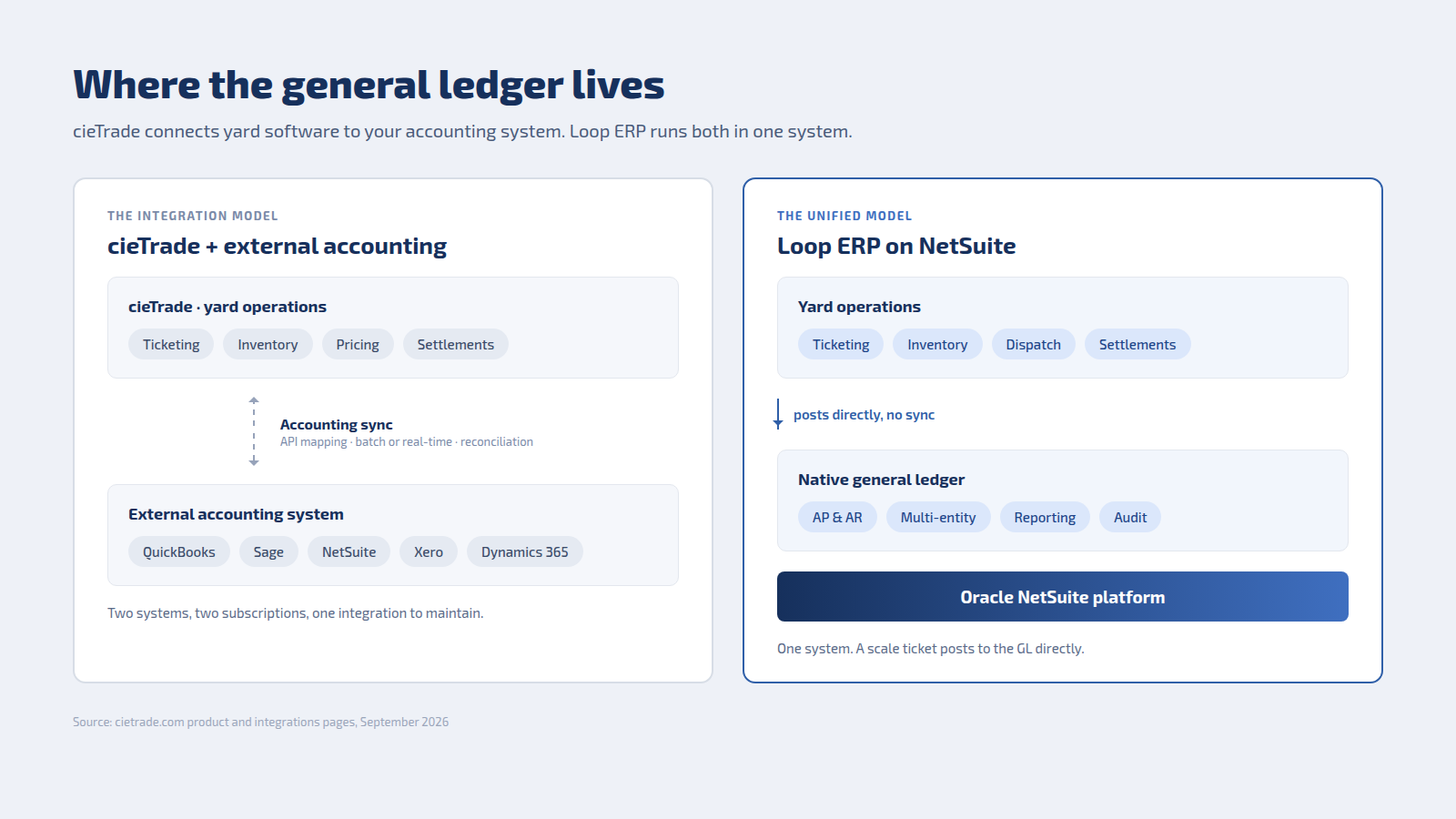
Built inside NetSuite from the ground up, so there's no integration to maintain because there's no second system to connect
A scale ticket, settlement, or inventory adjustment posts to the GL the instant it's recorded, not on the next sync cycle
One data model means one version of inventory value, one version of customer balances, one version of the numbers finance is looking at
Bottom line: This is the core difference between the two products. cieTrade connects to your accounting system. Loop is part of it.
Loop ERP vs cieTrade: Where the general ledger lives
D. Global Reach and Compliance
cieTrade:
Built with international trade in mind, including ocean booking and export documentation for brokers moving material across borders
Compliance and reporting features are oriented toward trading and shipment paperwork rather than financial consolidation
Financial controls and audit readiness depend on whichever accounting system it's connected to, not cieTrade itself
Loop ERP:
Inherits NetSuite's multi-currency, multi-subsidiary, and global tax capability for companies trading or operating across borders
Financial consolidation, intercompany eliminations, and audit-grade controls come from the same platform running operations, not a separate finance stack layered on top
One system means one set of controls to audit, not two systems whose data has to be shown to agree
Bottom line: Both platforms can support cross-border trade. Loop's advantage shows up at consolidation and close, when operational and financial data need to agree without a manual reconciliation step.
E. Cost Considerations
cieTrade:
Pricing isn't published; quotes require contacting the vendor directly, with reported starting costs in the range of a few hundred dollars per month for a small number of users, plus a separate training fee
Total cost includes the trading software license plus whatever accounting platform it's connected to, plus the integration itself
Review sites note that custom folder settings and reporting have sometimes needed vendor support to maintain after updates
Loop ERP:
One license covers operations and finance together, so there's no separate accounting platform or integration fee to budget for
Per-seat pricing that scales with the number of users a business actually runs, not a fixed enterprise package sized for a bigger company
Total cost of ownership is easier to forecast because it isn't split across two vendors and a middleware layer
Bottom line: A side-by-side software price may look close. The real comparison is three line items (cieTrade, an accounting platform, and the integration between them) against one.
Why Loop Is the Better Fit
Loop ERP is the stronger fit for recyclers and traders who are done reconciling yard data against a separate accounting system, or who are outgrowing what a smaller accounting platform can support. It's a better match if your business looks like this:
Trading, ticketing, inventory, and finance need to run in the same database, so there's nothing to reconcile at month-end
A ticket posted on the yard floor needs to show up in the GL immediately, not after a nightly or on-demand sync
The financial core needs to be one already proven at scale, not a system built and marketed as an operational tool first
There's no appetite to maintain a sync schedule, a mapping layer, or the support tickets that come with connecting two separate systems
Growth plans include adding sites, subsidiaries, or material lines without a parallel expansion of two systems at once
Frequently Asked Questions
What's the difference between Loop ERP and cieTrade? cieTrade is trading and yard software built to connect to a separate accounting system. Loop ERP is built natively inside Oracle NetSuite, so operations and finance run in one system instead of two connected ones.
Is cieTrade a full ERP? No, and cieTrade doesn't claim to be. It markets itself as "best of breed" trading and yard software, meaning it's designed to sit alongside an accounting platform like QuickBooks, Sage, NetSuite, or Xero rather than replace one.
Does cieTrade support more than one accounting integration? Yes. cieTrade connects to QuickBooks, Sage, NetSuite, Xero, and, as of 2026, Microsoft Dynamics 365 Business Central. Each of those is a separate integration to configure and maintain, including the NetSuite connection, which runs alongside NetSuite rather than inside it.
Does cieTrade include native financial management? No. Financial management runs through whichever connected accounting platform a customer chooses. Loop ERP includes financial management (GL, AR/AP, multi-entity consolidation) natively, on the same platform running operations.
Can Loop ERP replace cieTrade's trading and yard functionality? Yes. Loop supports the same operational depth cieTrade offers, ticketing, grading, spot and contract pricing, index formulas, and settlements, with those transactions posting directly to the general ledger instead of a separate accounting system.
Conclusion
cieTrade earned its reputation the hard way, with two decades of real trading depth built for operators who move commodities by grade, lot, and formula pricing. It's a mature, capable product in the lane it set out to serve, and for a trading operation that already handles accounting elsewhere, it can be a reasonable fit.
Loop ERP starts from a different premise. Instead of pairing strong yard software with a separate accounting system, it builds both into one platform on a financial core, Oracle NetSuite, that already scales globally. For recyclers tired of reconciling two systems, or outgrowing whatever sits behind cieTrade today, that architecture makes the difference at month-end.