
Summer builds inventory fast. Construction and demolition ramp up, industrial accounts run overtime, and material comes in faster than it goes out. By August, most yards are carrying more tonnage than they were in April, and a good chunk of it has been sitting in the same bin since June.
Nobody put it there on purpose. It just accumulated, one load at a time, while everyone was busy processing what came in that day. The problem is that aging inventory doesn't show up as a line item anyone reviews weekly. It shows up as tied-up capital, shrinking yard space, and margin that quietly erodes the longer material sits, and by the time it's obvious, the cost has already been paid.
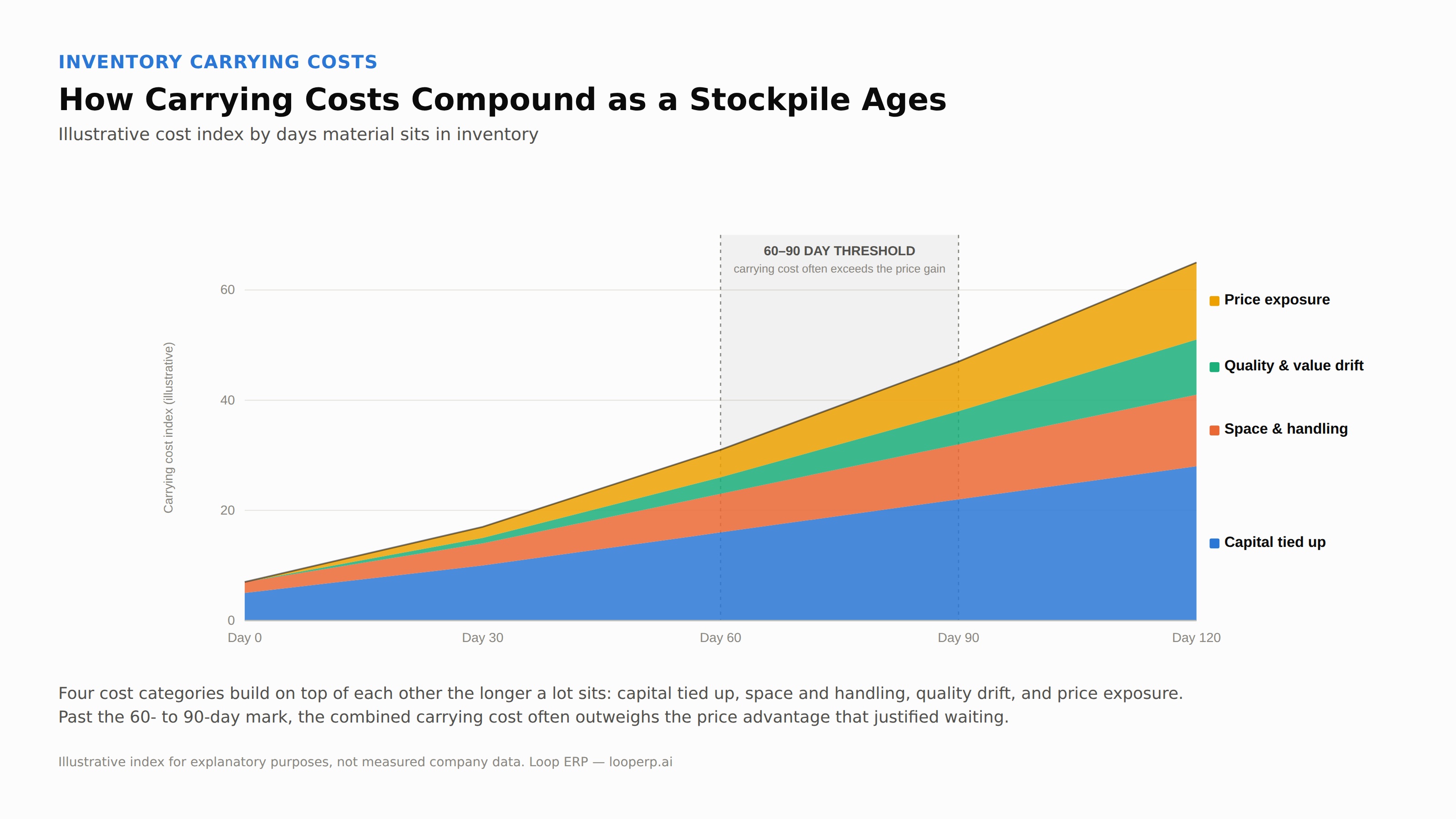
Ask most operations managers what a stockpile costs and they'll price the material. That's only part of the number. Every ton sitting in a bin is also carrying costs that don't show up until someone adds them up:
Capital tied up. Material sitting in inventory is cash the business already spent and hasn't recovered. The longer it sits, the longer that capital is out of play. It can't fund the next purchase, cover payroll, or go toward equipment.
Space and handling. A yard only has so much square footage. Aging material occupies bins, blocks staging areas, and forces awkward double-handling when fresher loads need the same space. Every time material gets moved to make room, that's labor and equipment time spent on material that isn't generating revenue.
Quality and value drift. Some materials degrade with exposure: moisture, oxidation, contamination from commingled storage. What was graded and priced at intake in June may not grade the same in September, and that difference gets discovered at settlement, not before.
Price exposure. Commodity markets move. Material bought at a June price and sold in September is exposed to whatever the market did in between, and the holding period is exactly what turns price volatility into a real gain or loss on the books.
None of this is a processing problem. It's a visibility problem. The material isn't costing more because it's worse; it's costing more because nobody could see how long it had been sitting until it was already a problem.
Seasonal buildup makes this worse for a simple reason: volume outpaces attention. When intake is running hot, the operational focus goes to what's coming through the scale house today, not what's already sitting in the yard from six weeks ago. Older lots get pushed to the back (literally and in terms of who's tracking them) while newer material takes priority for processing and outbound orders.
That's how a yard ends up processing material in reverse order of what makes financial sense: newest in, newest out, while the oldest, most capital-intensive material keeps aging in place. It's not a bad habit. It's what happens by default when no system actively surfaces which lots need attention.
Fixing this starts on the yard floor, before it's an ERP problem. A few organizational habits make aging visible instead of hidden:
Zone by intake date, not just by material grade. Grading tells you what a lot is. It doesn't tell you how long it's been there. Pairing grade-based zones with a visible intake-date marker — a tag, a card, a chalk mark on the bin — means anyone walking the yard can see age at a glance, not just composition.
Set aging thresholds by material type. Not everything ages the same way. A material that holds value in dry storage for months is a different risk than one where thirty days is already a problem. Set a threshold per material category, the point at which a lot needs to move, get reprocessed, or get flagged for sale, instead of applying one blanket rule to everything in the yard.
Build FIFO into the physical layout, not just the policy. First-in-first-out only works if it's easier to pull the old lot than the new one. That means staging older material where it's accessible, not buried behind three months of newer loads because that's where there was room when it came in.
Make aging visible to more than one person. If tracking which lots are getting old lives in one supervisor's head, it disappears the day that person is out sick or handling something else. The yard needs a shared, visible system — physical or digital — that doesn't depend on one person's memory.
Bin organization solves the physical side. It doesn't solve the reporting side, and that's where most yards lose the thread, because nobody checks inventory age against financial exposure until it's review time.
This is what material lot tracking inside an ERP is built to catch. Every inbound ticket creates a lot record with an intake date, quantity, grade, and cost basis, and that record stays attached to the material through every regrade and movement — so instead of relying on a chalk mark, the system knows exactly how long every lot has been sitting and what it's worth.
That matters because inventory aging isn't just a yard-floor question; it's a finance question, too. A connected inventory management system that ties lot-level tracking directly to the general ledger means aging inventory isn't a mystery discovered at month-end—it's visible in real time, alongside what it's actually costing in carrying value. When operations and finance look at the same lot data instead of reconciling two different pictures of it, aging material gets flagged and moved while there's still time to act, not after it's already eaten the margin.
That's the difference between managing stockpiles reactively: discovering the problem during a slow season or a physical count and managing them as a routine part of running the yard. The lots that need attention surface on their own, sorted by age and value, instead of waiting to be found.
Summer stockpiles aren't avoidable. Volume is going to build when intake outpaces outbound, and that's true of a well-run yard as much as any other. What's avoidable is letting that material age invisibly. The yards that come out of peak season without a margin surprise are the ones where aging inventory was visible the whole way through: organized to support turnover on the floor, and tracked at the lot level so operations and finance both know exactly what's sitting, how long it's been there, and what it's costing.
If summer left your yard with more aging inventory than you'd like to explain at month-end close, that's usually a visibility gap, not an operations problem. Talk to us about how Loop ERP's lot tracking and inventory management tie stockpile age directly to your financials, so aging material gets caught while there's still a decision to make about it.
How do you actually calculate the carrying cost of aging scrap inventory?
Start with the material's cost basis at intake, then add what it costs to hold: the capital that could be deployed elsewhere, the space and handling required to keep it staged, and any quality or weight loss from extended storage. Compare that running cost against the material's current market value. If holding costs and price drift together outweigh what the lot is worth today versus at intake, it's past the point where holding it made sense.
How long is too long to hold a stockpile before it starts costing more than it's worth?
There's no single number — it depends on the material. Some grades hold value in dry storage for months with minimal risk; others start losing value or accuracy within weeks due to moisture, contamination, or market movement. The more useful approach is setting an aging threshold per material type based on how it actually behaves in storage, then treating any lot past that threshold as one that needs a decision, not just more time on the shelf.
Isn't physically tagging bins with intake dates enough to manage this, or do we need lot tracking in the ERP?
Physical tags solve visibility on the yard floor, but they don't connect to what a lot is actually costing on the books, and they disappear the moment the tag fades, falls off, or the one person who knows the system is out. ERP-based lot tracking keeps the same information (intake date, grade, cost basis) attached to the material electronically through every regrade and movement, so operations and finance work from the same record instead of reconciling a chalk mark against a spreadsheet after the fact.
Powerful, self-serve product and growth analytics to help you convert, engage.
Blogs

October 9, 2026
Weight Tickets, Cost Per Ton, and ERP: How Aggregate Producers Connect Operations to Finance

October 1, 2026
Building the 2027 Budget: How to Make the ROI Case for a Scrap ERP Before Year-End

September 23, 2026
Closing the Books on Q3: Why Manual Reconciliation Breaks Down at Quarter-End