A circular economy ERP is an enterprise resource planning system built for businesses that recover, process, and resell materials by weight, grade, and lot rather than by unit and SKU. It connects scale tickets, dispatch, inventory, settlements, and the general ledger inside one system, so operations and finance share the same numbers in real time. Scrap yards, recycling operations, aggregate quarries, brokerages, and other materials businesses use it to replace the patchwork of spreadsheets, scale software, and generic ERPs that most of them have outgrown.
This guide explains what a circular economy ERP actually does, how it differs from a generic ERP, what it looks like inside scrap, aggregate, and electronics recycling operations, and what to evaluate before buying one. It is written for operations leaders, controllers, and CFOs who already know their current setup is costing them money and want a clear answer on what to do about it.
Most ERP systems on the market were designed for manufacturers and distributors. They assume you sell discrete units with fixed prices, that inventory comes in countable boxes, and that a sale ends when an invoice is generated. None of that describes a scrap yard, a quarry, or an electronics recycler.
In a materials business, the same ton of metal can change cost basis three times in a day. A load arrives, gets weighed, gets regraded after sorting, gets blended with another load, and goes out the door under a different commodity code. The price is provisional until the assay comes back. The customer pays based on a published index that moves daily. The supplier gets settled on a different cycle than the buyer. Compliance reporting depends on documents the generic ERP cannot generate.
Operators get around this by stitching together tools. Scale software talks to one system. Dispatch lives on a whiteboard or in a separate app. Settlements get calculated in spreadsheets and rekeyed into accounting. The CFO closes the books two weeks after month-end because half the data has to be reconstructed by hand.
The cost of that setup is rarely on a single line in the budget, but it shows up everywhere: in delayed financial visibility, in margin leaks no one catches until quarter-end, in compliance findings, in the time senior people spend reconciling instead of running the business. A circular economy ERP exists to eliminate that overhead.
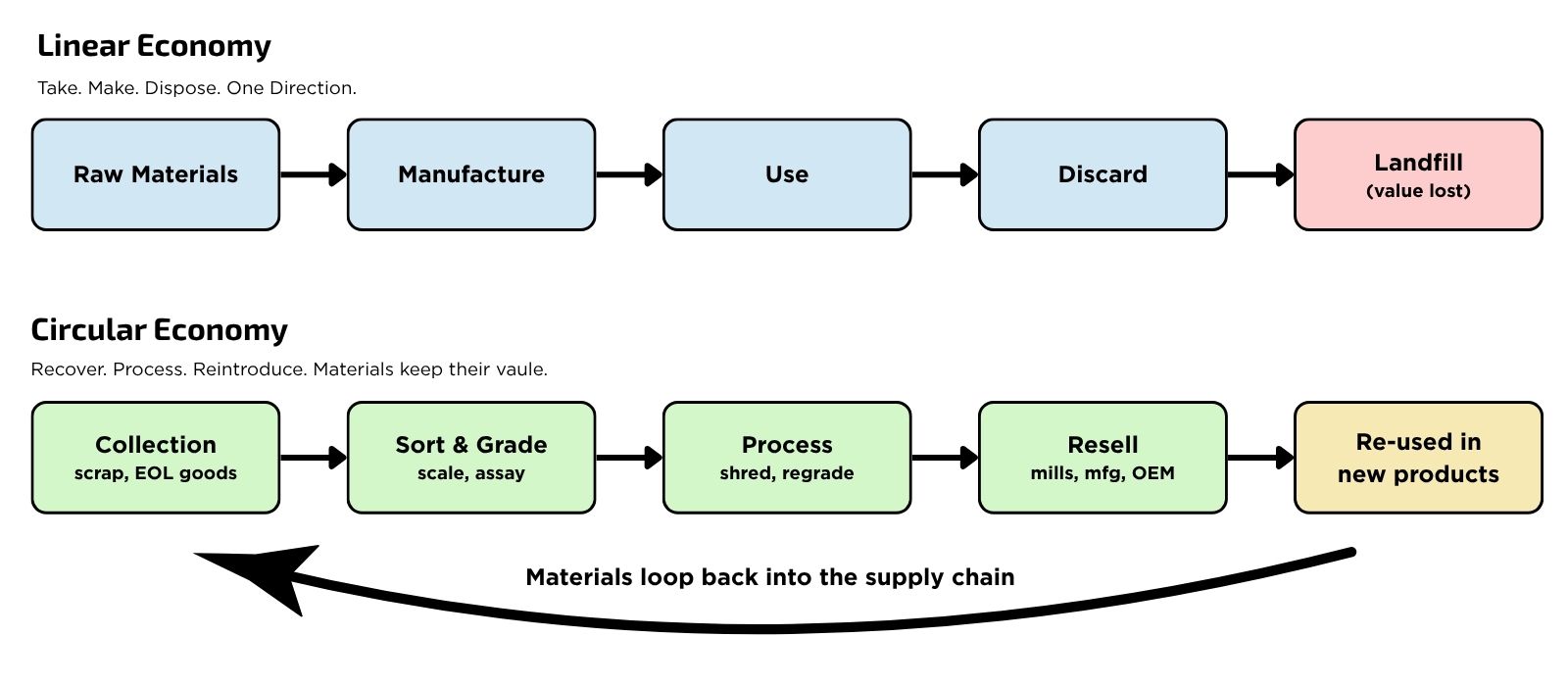
The circular economy is often described in environmental terms, but the businesses that operate inside it are run on commercial fundamentals: tonnage, grade, market index, and margin per ton. The circular part describes how materials move. The economy part is how operators make money doing it.
Industries that operate inside the circular economy include scrap metal recycling, electronics recycling, tire recycling, battery recycling, automotive recycling, plastic and glass recycling, compost processing, aggregate quarrying, concrete recycling, hay and forage, fish and seafood processing, agricultural commodities, municipal waste, brokerage, and similar materials-based industries. They are capital-intensive, volume-driven, and exposed to commodity price swings on both sides of the deal.
What ties them together operationally is the way value is created. A truck arrives, the load is weighed, materials are sorted or graded, processing changes the form or chemistry, and the finished product goes out to a buyer who pays against a published price or contract. Every step has to be tracked by weight and grade. Every step touches both operations and finance. And every step generates compliance data that someone has to keep on file.
That is what a circular economy ERP has to model out of the box. Not after a six-month customization project.
A circular economy ERP is a single platform that handles the full operational and financial picture of a materials business. It captures inbound logistics, scale tickets, lot tracking, processing transactions, outbound logistics, settlements, invoicing, and the general ledger in one place, with one set of master data.
The system speaks the language of the yard out of the box. It knows what a scale ticket is. It handles regrades, splits, blends, and consolidations. It supports provisional pricing for commodities that settle later against an index or assay. It tracks inventory by bin, stockpile, lot, or serial number, depending on what the material requires. It posts to the general ledger automatically as transactions happen, so finance is never waiting for operations to send a spreadsheet.
It also handles the things that do not show up in a yard but show up in the corporate office: AR, AP, multi-entity consolidation, multi-currency, revenue recognition, audit trails, role-based access. A purpose-built circular economy ERP has to do both jobs equally well, because cutting either one out forces the customer back into the patchwork they were trying to escape.
The Loop ERP product, for example, is a cloud-based ERP built on Oracle NetSuite that unifies logistics, inventory, operations, and finance with real-time visibility, AI-driven optimization, and enterprise cloud security. Building on NetSuite means the financial backbone is already proven at scale. The materials-specific layer is what turns it into a circular economy ERP.

The differences are not surface-level. They run all the way down to the data model. A generic ERP starts with a SKU and a unit of measure and assumes both stay constant through the transaction. A circular economy ERP starts with a load and a grade and assumes both can change at any step.
A few of the gaps that matter most in practice:
Weight-based transactions, not units. Generic ERPs treat weight as a custom field. A circular economy ERP treats weight as a first-class value. Scale tickets, gross/tare/net calculations, weight tolerances, and weight-based pricing are core, not bolt-ons.
Provisional pricing. Most materials transactions do not settle at the moment of delivery. The price firms up days or weeks later when an assay completes, an index publishes, or a downstream payment lands. A circular economy ERP carries the provisional value, books accruals, and trues up automatically when the final price is known.
Regrade, blend, and split. Inventory transformations happen constantly in a yard. A load gets sorted into three grades. Two grades get blended for a customer order. A third gets reclassified after testing. Generic ERPs require a custom transaction type and a manual journal for each one. A circular economy ERP handles them as standard inventory movements that update cost basis and the GL automatically.
Reverse logistics. Materials businesses run logistics in two directions. Material comes in for processing and finished product goes out for sale, but they share trucks, drivers, routes, and customers. A circular economy ERP plans both directions in one dispatch view rather than treating outbound as the only direction that matters.
Compliance built in. NMVTIS, R2v3, e-Stewards, MSHA, MSGP, EPR reporting, hazmat manifests, and hazardous materials documentation are standard requirements in these industries, not edge cases. A circular economy ERP supports them out of the box.
Most operators evaluating a materials ERP are choosing among three options: a generic Tier 1 ERP like SAP or Microsoft Dynamics, a standalone yard or scale management application, or a purpose-built circular economy ERP. Here is how they line up against the capabilities that matter in a materials operation.
The pattern shows up clearly. Generic ERPs handle finance well but force materials operators into custom development for everything specific to the yard. Standalone yard software handles the scale house and inventory but stops at the GL. A circular economy ERP is the only category that delivers both sides of the operation in one system.
Across verticals, the same capabilities show up on every serious buyer's checklist. If a system cannot deliver these natively, it is not a circular economy ERP. It is a generic ERP with a sales pitch.
Inbound and outbound logistics. Dispatch, route planning, driver management, scale ticket capture at the gate, and load tracking from origin to destination. Mobile access for drivers and yard staff so data is captured at the source instead of rekeyed later. Loop ERP handles this through its dispatch and driver management and inbound logistics modules.
Material and lot tracking with traceability. Every load tagged with a unique identifier, every transformation tracked, full chain-of-custody from intake to sale. Critical for regulated streams like electronics, batteries, and end-of-life vehicles.
Real-time inventory by location and form. Bins, stockpiles, racks, warehouses. Inventory that updates the moment a scale ticket posts or a regrade is performed, not at end of day or end of shift.
Provisional pricing and settlements. Carry the open value, accrue the right amount, and post the true-up automatically when final pricing lands. Handle multiple settlement types: weight-based, percentage, formula, index-linked.
Reverse logistics. Recovered materials, returned product, and customer pickups handled in the same logistics flow as outbound sales. Routing, weight capture, and cost handling integrated end-to-end.
Compliance and sustainability reporting. Material recovery rates, waste diversion, regulated commodity tracking, audit-ready exports. Environmental reporting that does not require a separate analyst to compile.
Full financial suite. AR, AP, GL, multi-entity, multi-currency, revenue recognition, real-time dashboards. The same financial backbone the corporate office expects from any ERP, with the operational layer feeding it directly.
Netting. For operations that buy and sell with the same counterparties, a circular economy ERP handles net settlement automatically, offsetting payables against receivables without manual reconciliation. Brokers, traders, and scrap operators routinely sit on both sides of the ledger with the same mill, processor, or supplier. Netting collapses that into a single position instead of two parallel ones.
Scale and camera integration. Scale and camera integration captures photos of each load at the gate and attaches them directly to the scale ticket. Contamination flags, non-conforming material, and grade disputes all have a visual record tied to the transaction, so the conversation with a customer or supplier starts from evidence, not memory.
AI-driven insights and automation. Demand forecasting, supplier optimization, route optimization, anomaly detection on margin and pricing. AI is most useful in materials businesses where the volume of weight-based transactions makes patterns invisible to a human eye.
See these capabilities running in a real operation. Book a demo.
Scrap and recycling operations live or die on speed at the scale and accuracy in the back office. A circular economy ERP wires both ends of that workflow together.
The day starts when a truck arrives at the gate. The driver is identified, the vehicle is tared, and the load is weighed. The yard team assigns a commodity code (#1 HMS, #2 prepared, shred, copper bare bright, aluminum cast, and so on) and a grade. The scale ticket captures the gross, tare, and net weight along with photos and any flags for moisture, contamination, or non-conforming material.
Scale and camera integration is what makes that ticket usable later. Photos of the load are attached to the ticket at the moment of capture, alongside contamination flags and grade notes. When a supplier disputes a downgrade or a customer questions a deduction, the answer is one record with a picture, not a phone call to the yard hand who weighed the truck three weeks ago.
That single ticket becomes the foundation for everything downstream. The purchase settlement posts to AP. The inventory record updates by grade and yard location. The cost basis is recorded against the vendor and the commodity. The general ledger entry posts in real time. There is no spreadsheet, no manual journal, no batch upload at end of day.
If the load is regraded after sorting, a new transaction posts. If three loads are blended for a mill order, the consolidation posts. If material is shredded or processed, the inventory transformation posts. If the regulator requires a NMVTIS submission for a catalytic converter purchase, the document is generated automatically from the ticket data. Loop ERP handles each of these inside its scrap and waste materials industry workflow.
On the outbound side, a contracted shipment to a mill or end buyer pulls inventory by grade, captures truck and rail data, and posts the sale and the AR entry simultaneously. If the price is provisional pending an assay, the system carries the open value until final settlement and trues up automatically. The CFO sees real-time exposure to commodity prices, open settlements on both sides, and the gross margin per ton without waiting for a month-end close.
See how Loop ERP handles scrap and recycling operations end-to-end.
Aggregate operations have a different rhythm than scrap, but the same operational and financial integration challenge. A quarry produces sand, gravel, crushed stone, base, or specialty product, sells most of it by the ton, delivers it on company trucks or contract haulers, and bills against a mix of spot pricing, contract pricing, and project-based agreements.
The day at a quarry starts at the scale house. A customer truck (or company truck headed to a project) is weighed, the product code is selected, the destination is captured, and the ticket prints. That ticket drives the invoice, the inventory deduction at the stockpile, the dispatch confirmation, and the GL entry. If the load is going to a paving project under a contract, the price pulls from the contract terms automatically. If it is a spot sale, the day's posted price applies.
The challenge most aggregate operators have without a circular economy ERP is that the scale house, the dispatch board, and the accounting system live in different worlds. Tickets are exported nightly, prices are updated manually, and exceptions get worked out by phone the next day. Closing the books takes longer than it should. Margin per project is unclear until weeks after pour.
A circular economy ERP collapses that. Scale tickets, dispatch, hauler settlements, customer billing, royalty calculations, and project costing run inside the same system. The controller can see margin per ton, per pit, per customer, and per contract in real time. Loop ERP for aggregate is purpose-built for this workflow.
See how Loop ERP handles aggregate operations end-to-end.
Electronics recycling has the heaviest compliance burden of any materials vertical. Every ton of e-waste is a chain-of-custody question. Every device can carry data, regulated substances, or recoverable precious metals. Downstream auditors expect serialized records, not summary totals. R2v3 and e-Stewards certifications require documented evidence at every step.
A circular economy ERP built for electronics recycling has to track at the lot, asset, and serial level depending on the stream. A pallet of mixed e-scrap arrives, gets weighed, gets sorted into ITAD-eligible assets and shred-grade material. ITAD assets get serialized, data-wiped, tested, and either resold or sent to refurbishment. Shred-grade material is processed and the resulting commodity output is graded and sold to downstream smelters.
Every step generates a record. Every record links back to the source load, the source customer, and the eventual downstream destination. When a corporate customer asks for proof of destruction or a downstream auditor asks for evidence that no material went to a non-certified processor, the answer is one report, not a week of compiling spreadsheets. Loop ERP for electronics recycling is built around this serialized chain-of-custody model.
The financial side carries the same complexity. Revenue can come from ITAD asset resale, commodity sales, certificate-of-destruction services, recycling fees, and reverse-logistics service contracts. A circular economy ERP handles all of those revenue streams in one set of books with the right revenue recognition rules applied automatically.
See how Loop ERP handles electronics recycling end-to-end.
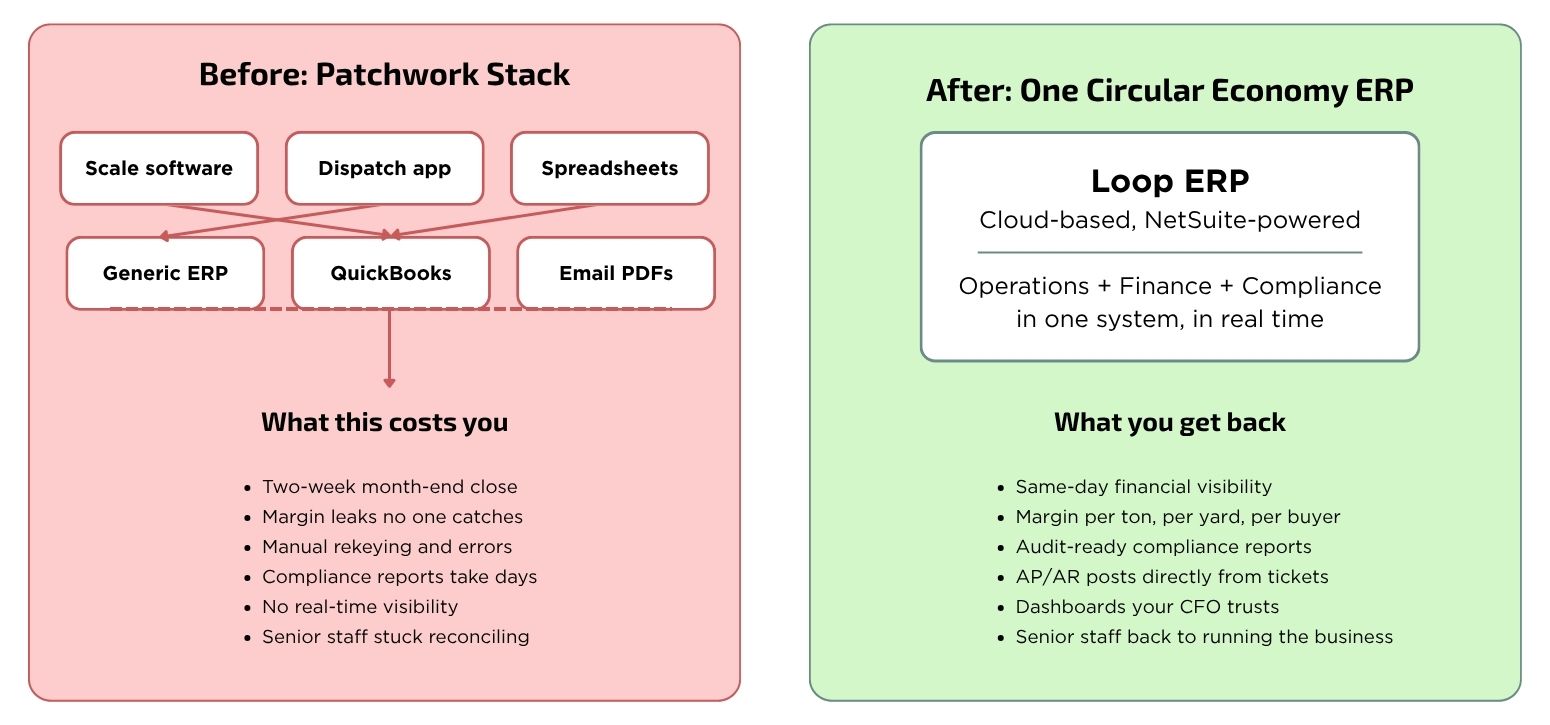
Most operators can name the obvious costs of their current stack: a few software subscriptions, an integration consultant on retainer, the IT person who keeps the bridge between scale software and accounting alive. Those are the costs on the budget.
The costs that are not on the budget are bigger. A two-week lag between operations and finance means the team is making purchasing and pricing decisions on stale data. Margin leaks at the regrade or the consolidation step are not visible until quarter-end, by which time the loss has compounded. Senior staff spend a quarter of their time reconciling tickets to invoices, settlements to payments, and inventory to the GL. Compliance reporting eats days of effort at the wrong moment, usually when the auditor is already on site.
A circular economy ERP eliminates those costs because they were never separate problems. They were all the same problem: operations data and financial data living in different systems with a manual bridge between them. Fix the bridge by collapsing the two systems into one and the costs disappear with it.
The pattern is the same across every operator who replaces the patchwork. Faster billing. A real month-end close. A scale house and an accounting team that are not arguing about whose number is right.
The compliance burden in materials businesses is uneven across verticals but real in all of them. Scrap yards have to support NMVTIS, LeadsOnline, and state-level catalytic converter rules. Electronics recyclers have to meet R2v3 or e-Stewards downstream documentation requirements. Aggregate operators have to track MSHA reporting, MSGP Sector N stormwater, and royalty obligations on quarried material. Tire and battery recyclers carry hazmat documentation. Compost facilities answer to state and federal contamination rules.
A generic ERP treats compliance as a custom report at best. A circular economy ERP captures the data at the source. Every scale ticket, every regrade, every load that leaves the yard generates the data the regulator wants in the format the regulator expects. When an audit happens, the answer is a query, not a project.
Traceability works the same way. A buyer asks where a specific lot of finished product came from. A downstream auditor asks for evidence that a stream of e-waste reached a certified processor. A corporate customer asks for proof of destruction on a batch of decommissioned servers. In all three cases the answer comes from the same chain-of-custody record that was created automatically when the material first entered the yard.
Most evaluations come down to a handful of questions. Asking them up front saves months later.
Does it handle scale tickets and weight-based transactions natively?
Not through a third-party connector or a workaround. The data model has to treat weight as a primary attribute, not as a custom field added on after the sale.
Does operations post to the GL in real time?
If the answer is “we batch-export every night” or “we have a sync utility,” the system is two systems with a bridge. The whole point of a circular economy ERP is that the bridge does not exist because the two layers are one platform.
Is it built on a platform that will scale with the business?
Industry-specific software built on legacy infrastructure carries a different set of problems: brittle integrations, slow performance at multi-site scale, and update cycles that break customizations. Cloud-native architecture on a proven platform like NetSuite avoids most of those traps.
Does it support the compliance regimes that apply to the business?
NMVTIS, R2v3, e-Stewards, MSHA, MSGP, EPR, hazmat, certificate of destruction, depending on the vertical. Ask for examples of each one running in production for an existing customer.
Does it carry provisional pricing correctly?
If the answer is “we use a journal entry to true up,” that is a sign the system was not designed for weight-and-grade settlement. A proper circular economy ERP carries the provisional value through the books and trues up automatically.
How fast is implementation?
Materials businesses do not have appetite for an 18-month implementation. Loop ERP implementations typically run from a few weeks to a few months depending on the size and complexity of the operation.
Is the security and access model enterprise-grade?
Role-based access, field-level permissions, audit trails, encryption in transit and at rest, two-factor authentication, SSO, SOC 1 and SOC 2 compliance. These are non-negotiable for any company serious about its data.
What integrations come standard?
Scale software, EDI trading partners, CRMs, BI tools, freight systems, bank feeds. A circular economy ERP should connect to the rest of the operating environment without middleware lock-in.
Industry-specific functionality is necessary but not sufficient. The best operational layer in the world running on a brittle platform creates the same problems the buyer was trying to escape: outages, slow performance, integration breakage at every upgrade, and a vendor who cannot keep pace as the business grows.
A circular economy ERP built on Oracle NetSuite inherits the financial backbone, the cloud infrastructure, and the security profile of one of the most-used cloud ERPs in the world. The materials-specific layer sits on top, purpose-built for the workflows generic NetSuite does not know how to handle. The buyer gets industry fit and platform stability at the same time, instead of choosing between them. Loop ERP is built this way, by people who have lived the pain of running materials businesses on systems that were never designed for them.
Implementation timelines vary based on size and complexity. A single yard with one entity can be live in a few weeks. A multi-site, multi-entity, multi-currency operation usually runs a few months. The variables that drive timeline are the number of sites, the number of commodity streams, the number of integrations, the depth of historical data migration, and the cleanliness of the data being migrated.
The phases that matter most are scoping, configuration, data migration, integration, user training, and go-live. The configuration phase is where industry fit shows up. If the system is purpose-built for materials businesses, configuration is mostly turning on what is already there. If the system is generic, configuration becomes development, which extends timeline and risk.
Loop ERP implementation services, training, and ongoing support are run by the same team that built the platform, which removes the handoff gap that breaks most ERP implementations.
A circular economy ERP is the right tool for any business that recovers, processes, or trades materials at volume and has outgrown the spreadsheet-and-generic-ERP patchwork. It connects operations, inventory, logistics, and finance inside one platform, eliminates the manual bridges between systems, and gives the operations team and the corporate office the same numbers in real time.
The shorthand from the operators who run on Loop ERP every day: one login, one system, total control. Closing the loop between operations and finance. Built for materials businesses, not adapted for them.
Loop ERP is a member of the Recycled Materials Association (ReMA) and CARI-ACIR (Canadian Association of Recycling Industries), reflecting our commitment to the scrap and recycling industry and the operators who run it.
If the current setup is costing money in places no one can quite point to, that is the problem a circular economy ERP is built to fix.
See how Loop ERP works in your operation. Book a demo.

An enterprise resource planning system built for businesses that make money recovering, processing, and reselling materials by weight and grade rather than by unit and SKU.
Yard management systems and standalone recycling software stop at the operational layer: scale tickets, dispatch, inventory. There is no general ledger underneath. A circular economy ERP includes both, with finance posting the moment a ticket is created. One system, not two with a sync.
NetSuite by itself is the financial layer. It does not handle scale tickets, regrades, provisional pricing, or weight-based inventory. A circular economy ERP built on NetSuite (Loop ERP, for example) adds the materials-specific operational layer on top, so the customer gets both layers in one system without a separate yard application bolted to the side.
Scrap and waste materials, electronics recycling, aggregate, brokerage, hay and forage, tire recycling, compost, concrete recycling, fish and seafood processing, agricultural commodities, municipal waste, plastic and glass recycling, battery recycling, automotive recycling, and similar materials-based industries. The full list of Loop ERP industries is on the website.
Single-yard operations go live in a few weeks. Multi-site, multi-entity rollouts run a few months. The biggest variable is data quality going in, not the software itself.
Yes, and not as an afterthought. Role-based access, field-level permissions, encryption in transit and at rest, two-factor authentication, SSO, SOC 1 and SOC 2 compliance. The same security stack any enterprise finance team requires from a system touching the GL.
Yes. The data is captured at the source, so the report writes itself. Loop ERP supports the compliance regimes that apply to its target industries out of the box, so an audit becomes a query instead of a project.
AI in a circular economy ERP earns its keep on demand forecasting, supplier optimization, route optimization, and anomaly detection on margin and pricing. Materials businesses generate enough weight-based transaction data that patterns are invisible to a human eye but obvious to a model. Loop ERP AI-driven insights work this way.
Pricing scales with users, sites, modules, and entities. Most operators find the total cost lower than the patchwork stack they replace, once spreadsheet labor, integration retainers, and the cost of delayed financial visibility get added up. Request pricing for a quote tied to your operation.
Yes. A circular economy ERP built on NetSuite includes a full financial suite, AR, AP, GL, multi-entity, multi-currency, revenue recognition, and replaces QuickBooks completely. Most operators consolidating off a patchwork stack retire QuickBooks during implementation.
Powerful, self-serve product and growth analytics to help you convert, engage.
Blogs
September 23, 2026
Closing the Books on Q3: Why Manual Reconciliation Breaks Down at Quarter-End
September 16, 2026
Material Traceability Software: What ESG and Compliance Teams Actually Need
September 10, 2026
Scale House Software Explained: Ticketing, Dispatch, and the Financial Handoff