
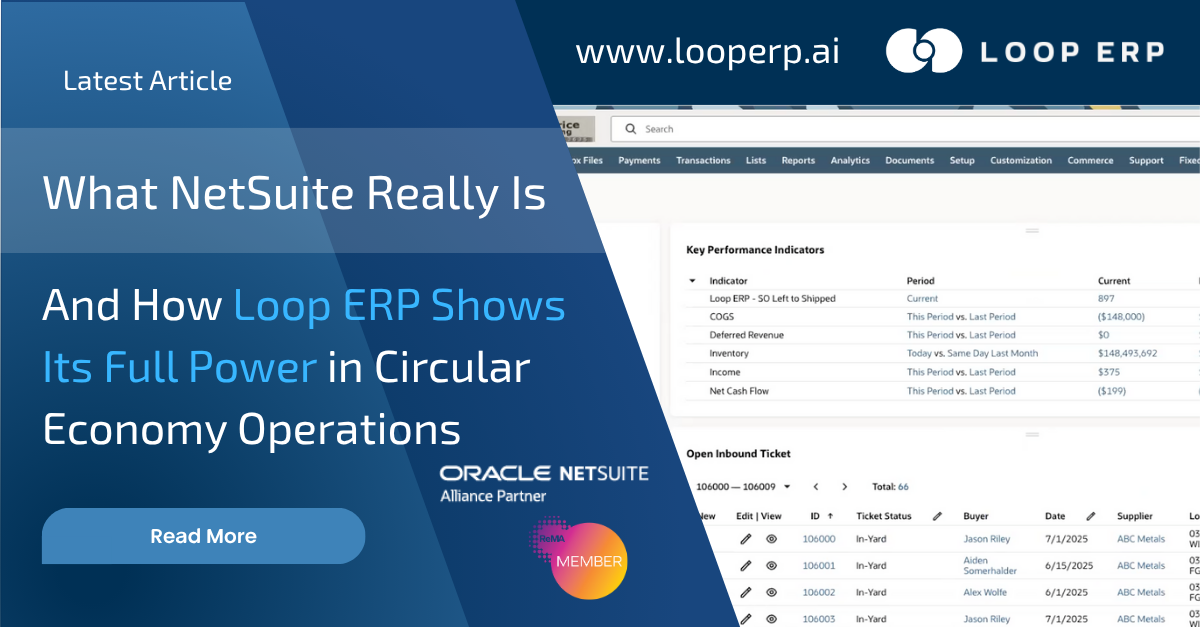
Most business leaders looking at ERP systems already know the limitations of basic accounting software. But understanding what NetSuite actually is and how it functions as a complete business backbone can be harder to grasp without real-world context.
That’s why in this article, instead of describing NetSuite in the abstract, we’ll explain it through the lens of Loop ERP, which is built directly integrated into NetSuite and designed for scrap metal recycling, aggregates, waste, brokerage, electronic recycling, plastics, and other circular-economy sectors.
If you want to know "What is NetSuite?" or "Why do companies choose it over traditional accounting tools?", Loop ERP is the clearest proof. Everything Loop does—ticketing, dispatch, yard operations, complex pricing, real-time GL impact—works because NetSuite provides the enterprise-grade foundation underneath.
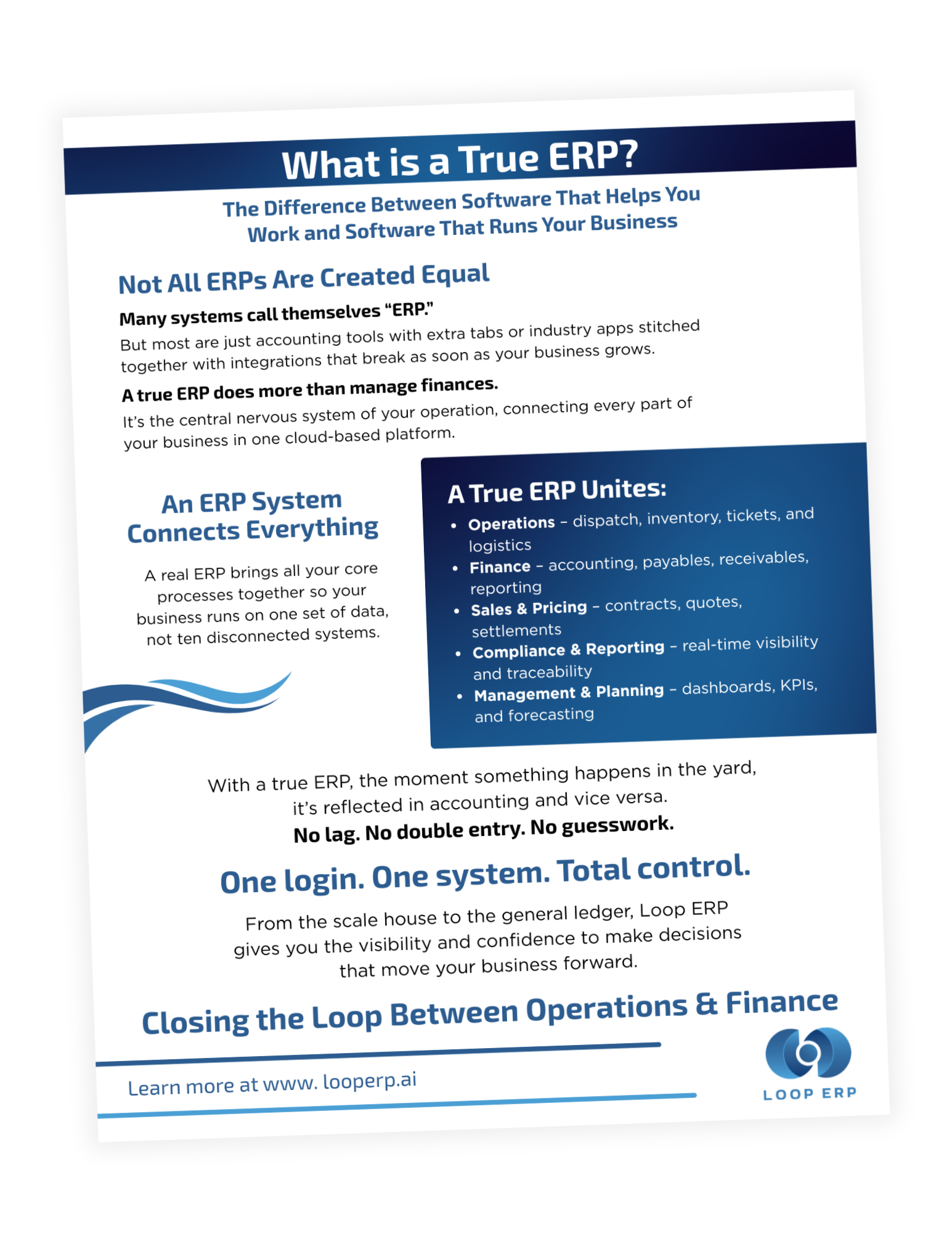
Download our 1-page guide that answers the question, What is a True ERP?
NetSuite is a cloud ERP system that manages a business’s financials, inventory, procurement, supply chain, reporting, and operations in one system. It replaces the patchwork of accounting tools, spreadsheets, and niche software that create silos across the business.
But this definition becomes even clearer when you look at Loop ERP’s modules:
Loop ERP is the operational layer that’s purpose-built for circular-economy industries. NetSuite is the financial and structural backbone holding everything together.
This is why NetSuite matters: it allows specialized solutions like Loop ERP to run high-volume, complex, multi-location operations without any fragile integrations or nightly syncs.
To understand what NetSuite is at a deeper level, visit the Loop ERP explanation here: What Is NetSuite?
NetSuite explains this distinction well. Accounting software manages only general ledger activities: AP, AR, cash, taxes, and financial close. ERP systems manage the entire business.
Loop ERP brings that comparison to life.
In other words, accounting software helps you "keep the books," but NetSuite helps you run the entire business, and Loop ERP shows exactly what that looks like in practice.
Instead of listing NetSuite features in isolation, here’s how each capability directly supports the way Loop ERP customers operate.
NetSuite’s unified financial engine means transactions don’t need batch uploads or reconciliations. Loop ERP uses this to deliver one of its most powerful advantages:
Every load, every ticket, every contract, every settlement impacts the general ledger in real time.
This matters for industries operating on tight margins and fluctuating prices. When a metal price changes, when moisture deductions shift, when a regrade occurs, Loop ERP posts accurate financials the moment operations make the change.
No other scrap, aggregate, or waste platform has this level of financial precision without custom integrations.
NetSuite stores all departments’ data in one place. Loop ERP builds operational workflows directly inside that model:
This allows leaders to open a single dashboard and see:
This level of visibility isn’t possible in a standalone accounting platform.
NetSuite’s scalability is what allows Loop ERP customers to expand without changing systems.
Loop ERP users often operate across:
NetSuite’s architecture makes all of this native. Loop ERP simply configures it for the real-world flow of materials and money in the circular economy.
NetSuite provides automation, approvals, and workflow tools. Loop ERP turns those into industry-specific, ready-to-use processes that don’t require expensive custom development.
Examples:
NetSuite provides the engine, Loop ERP provides the map.
NetSuite lets businesses activate or expand modules as needed. Loop ERP uses this to support fast, practical implementations for industries that don’t have time for multi-year projects.
Loop’s deployment may include:
You get the structure of NetSuite with modules that already match how your industry operates so teams don’t have to reinvent processes.
These industries face challenges that generic ERPs simply weren’t built for. NetSuite provides the power, but Loop ERP provides the fit.
Loop eliminates spreadsheet inventory by syncing all inbound, outbound, production, and regrade activity into NetSuite automatically.
Loop’s advanced pricing module handles vendor-specific rules, moisture, deductions, variable grades, and time-based formulas, all posting to NetSuite’s financials instantly.
NetSuite ensures full auditability while Loop tracks scale data, photos, QA, tickets, and material chains.
Loop consolidates everything—yard app, dispatch, finance, settlements—into one NetSuite-backed system.
NetSuite gives businesses a single operational and financial backbone. Loop ERP turns that backbone into a purpose-built ERP for circular economy industries that need real-time accuracy, traceability, operational workflows, and robust financial control.
Loop ERP proves what NetSuite is capable of:
If your business has outgrown accounting software, or you’re tired of bolt-on tools that fail to connect operations and finance, then it’s time to see how NetSuite + Loop ERP can transform your operations.
Book a consultation to see how Loop ERP and NetSuite solve the challenges of your industry.
Q: Is Loop ERP a replacement for NetSuite, or does it run on top of it?
Loop ERP runs directly inside NetSuite. It's built natively on the NetSuite platform, so there are no bolt-on connectors, no nightly syncs, and no middleware to maintain. Every Loop workflow, from scale tickets to dispatch to settlements, posts to NetSuite's general ledger in real time.
Q: Do I have to license NetSuite separately to use Loop ERP?
Yes. Loop ERP runs on NetSuite, so NetSuite licensing is part of your setup. We handle the NetSuite side for you during implementation, so you get one quote, one project plan, and one team to work with.
Q: Can I keep my existing accounting software, like QuickBooks?
QuickBooks and similar tools manage your books. They don't run your operations. Loop ERP and NetSuite replace both, so scale tickets, inventory, dispatch, contracts, and financials live in one system. Most of our customers move off QuickBooks because reconciling spreadsheets and disconnected tools is exactly what they came to us to solve.
Q: How long does a typical Loop ERP and NetSuite implementation take?
Most circular economy customers go live in a few months, not years. The timeline depends on the number of yards, integrations, and how many of Loop's industry modules you turn on at launch. We scope it before you sign, so you know what you're getting and when.
Q: Does Loop ERP work for single-yard operations, or only large multi-site businesses?
Both. NetSuite scales from one location to dozens, and Loop ERP is configured to match. A single-yard operator gets the same real-time GL, ticketing, and inventory accuracy as a multi-site processor. You only turn on the modules you need.
Q: What does "real-time GL impact" actually look like day to day?
When your operator finishes a scale ticket, the inventory value, the AP obligation, and the margin per load update in NetSuite immediately. Your finance team isn't waiting on end-of-day batches or chasing tickets at month-end. You can pull a profitability report at lunch and trust the numbers.
Q: Can NetSuite and Loop ERP handle multi-entity, multi-currency, and multi-state compliance?
Yes. NetSuite was built for multi-entity, multi-currency, and multi-jurisdiction operations. Loop ERP layers industry-specific compliance on top, including hazardous materials tracking, state-specific reporting, and material traceability. Customers operating across borders and state lines run it all from one login.
Q: Do I need an in-house IT team to run this?
No. NetSuite is cloud-based, so there's no server hardware to maintain, no manual upgrades, and no version drift across sites. Loop ERP's modules are pre-configured to fit how your industry works, so most teams run day-to-day operations without dedicated IT support.
Q: What industries is the NetSuite plus Loop ERP combination built for?
Loop ERP is purpose-built for circular economy and materials-based industries, including scrap metal recycling, aggregates, brokerage, electronics recycling, plastics and glass, battery recycling, automotive recycling, tire recycling, hay and forage, compost, concrete recycling, fish and seafood processing, agricultural commodities, and municipal waste facilities.
Powerful, self-serve product and growth analytics to help you convert, engage.
Blogs
September 10, 2026
Scale House Software Explained: Ticketing, Dispatch, and the Financial Handoff
September 3, 2026
What ERP Do Scrap Yards Use? A Buyer's Guide for Q4 Planning Season
August 27, 2026
When Inventory Aging Costs More Than the Material: How to Optimize Summer Stockpiles


