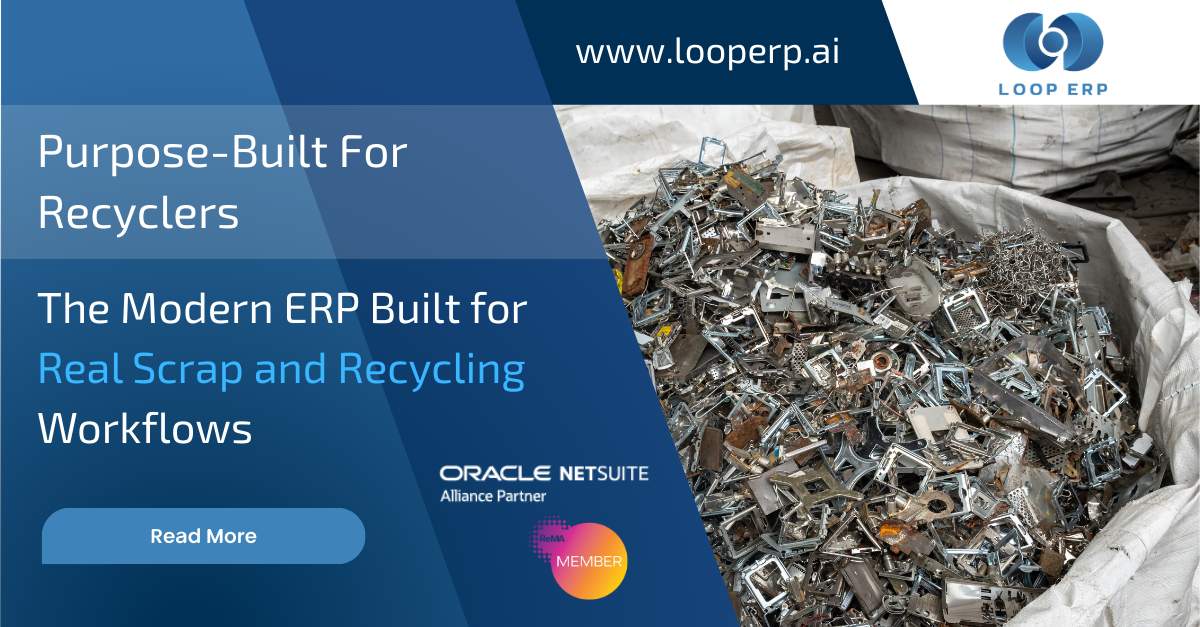
Recycling operations have outgrown the era of stitching together disconnected systems and tracking critical processes in spreadsheets that break at the worst moments. Today's scrap processors, recyclers, and circular-economy businesses need tools designed for the real-world way materials move, change grades, and affect profitability. Generic software was never built for that. The workarounds are expensive, the delays compound, and the financial picture is always a step behind the yard.
Loop ERP was built to fix that. It is a purpose-built recycling ERP that mirrors how yards, processing lines, and accounting offices actually operate — without forcing your team to adapt workflows to a system designed for something else entirely.
For years, recyclers have been stuck between two options that both fall short.
Generic ERPs offer strong financial infrastructure but struggle to manage scrap workflows without significant customization. Scale ticket logic, weight-based pricing, and settlement calculations are not standard features in these platforms. Getting them to work requires costly consulting hours and ongoing workarounds — and even then, operators usually end up running two systems: one for finance and one for everything else.
Niche point solutions are easier to get running, but they lack the financial depth and multi-location visibility to support a growing business. They work until you need them to do more. Then the cracks appear.
The recycling industry has always sat between these extremes. Companies need something modern, scalable, and actually aligned with how real yards operate: a platform that treats circular economy workflows with the same seriousness as manufacturing or distribution, without losing the industry-specific logic that makes those workflows unique. That is why Loop ERP was built.
Being purpose-built means more than using the right terminology. It means mapping real-world processes, eliminating friction between systems, and building technology that fits the job rather than requiring the job to fit the technology.
Material lifecycle management. Material does not behave like a traditional inventory item. It moves, changes weight, shifts grade, and often requires regrades or contamination adjustments. Loop ERP tracks the entire lifecycle — from inbound scale tickets through outbound shipments, regrades, lot-level adjustments, and weight changes — with every operational action tied to real-time financial impact. That level of visibility matters most for recyclers navigating thin margins and volatile commodity markets.
Pricing built for complexity. Scrap pricing reflects market volatility, supplier-specific contracts, contamination rules, and regional differences. Loop handles this through a robust pricing engine that supports market-indexed formulas, tiered pricing, supplier-based adjustments, material-grade exceptions, and contract-driven logic. This replaces the spreadsheets and manual calculations that slow processing and introduce risk.
Unified operations and financials. One of the biggest problems with recycling software has always been the disconnect between operations and accounting. With Loop, every ticket hits the general ledger instantly. Every regrade adjusts inventory and valuation. Every shipment updates revenue and cost in real time. There is no waiting for batch imports, no double entry, no surprises at month-end.
Simple interfaces for yard and office teams. Loop's "Simplicity That Works" design philosophy means clear interfaces, minimal steps to complete transactions, and workflows built around actual recycling operations. The yard application works on mobile and tablet. Operators can complete tickets, capture photos, confirm grades, and process loads without navigating complex ERP menus.
Multi-site and multi-entity control. Growth through new yards, acquisitions, or partnerships makes visibility harder. Loop supports consolidated reporting, site-level dashboards, inter-company financials, and shared or yard-specific pricing controls — so each location is part of one cohesive operation, not a standalone system.
Automated settlements. Settlement processing is one of the most time-consuming parts of running a recycling business. Loop automates settlement creation, applies the correct pricing, and records the financial entries with no additional manual steps. Accounting teams can generate accurate settlements quickly and consistently, without reconciling weight tickets, regrades, and pricing formulas by hand.
Several converging trends are accelerating the shift.
Operations have gotten more complex. Even smaller yards handle intricate pricing structures, compliance requirements, and high-frequency material movement. Systems built a decade ago cannot keep up with today's pace or regulatory expectations.
Operators are done with workarounds. When every workday involves bending the system to fit the job, errors increase, morale drops, and the real cost of bad software becomes clear. Teams need tools that match their world.
Financial visibility is now a baseline requirement. With commodity volatility, margin pressure, and rising operating costs, recyclers cannot afford financial data that is unclear or delayed. Real-time insight into cash flow, inventory valuation, and cost per load is now an operational necessity, not a competitive advantage.
Manual processes carry too much risk. Spreadsheets fail. Paper tickets get lost. Disconnected tools create blind spots that can cost thousands per transaction. Purpose-built platforms reduce that risk and replace it with accountability.
Most recyclers who move to Loop leave behind a stack of tools that were never built to work together: scale-house software that cannot connect to accounting, pricing spreadsheets with dozens of fragile formulas, legacy systems without real-time visibility, third-party dispatch tools, paper tickets, and manual reporting methods.
Loop brings the entire workflow into one platform — operations, logistics, inventory, pricing, settlements, and finance — so teams have one source of truth and one system to manage.
The benefits of switching to a purpose-built system are measurable and operational, not theoretical.
Margins improve when pricing is accurate and data is clean. Throughput increases when teams stop tracking things manually. Month-end becomes a process rather than a crisis when financial entries post in real time. Compliance strengthens when documentation is built into the workflow. And scalability becomes achievable when new yards, new teams, and new partnerships can all run on the same foundation without rebuilding processes from scratch.
The teams using Loop also report a meaningful improvement in day-to-day quality of work. Less busywork. Fewer errors. More time on the job that actually matters.
What does "purpose-built ERP for recyclers" actually mean?
It means the system was designed around the actual workflows of a recycling or circular economy business — scale tickets, weight-based inventory, commodity pricing, purchase settlements, regrades, and compliance documentation — rather than adapted from a platform built for manufacturing or distribution. A purpose-built recycling ERP does not require significant customization to fit the operation. The workflows are already there.
How is Loop ERP different from generic platforms like SAP or Microsoft Dynamics?
Generic ERP systems can be customized to accommodate scrap workflows, but the customization is substantial, expensive to maintain, and often results in a system that approximates the workflow rather than fitting it. Loop ERP is built natively on Oracle NetSuite, which means you get enterprise-grade financial infrastructure alongside operational workflows designed specifically for recycling and circular economy industries without choosing between the two.
What does Loop replace in a typical recycling operation?
Loop typically replaces a combination of scale-house software, pricing spreadsheets, a legacy ERP or accounting system, and manual settlement processes. The goal is to consolidate those tools into one system where operations data and financial data are always in sync.
Is Loop ERP only for scrap metal recyclers?
No. Loop is built for a range of materials-based and circular economy industries, including aggregate, brokerage, tire recycling, electronics recycling, compost, and similar operations where complex pricing, weight-based inventory, and the connection between yard activity and finance are everyday challenges.
If your operation is still managing with disconnected tools or software that was never quite right for the job, this is what a purpose-built alternative looks like.
Book a demo to see how Loop ERP connects yard operations, inventory, pricing, and finance in a single NetSuite-powered platform designed for recyclers.
Powerful, self-serve product and growth analytics to help you convert, engage.
Blogs
October 1, 2026
Building the 2027 Budget: How to Make the ROI Case for a Scrap ERP Before Year-End
September 23, 2026
Closing the Books on Q3: Why Manual Reconciliation Breaks Down at Quarter-End
September 16, 2026
Material Traceability Software: What ESG and Compliance Teams Actually Need